Usage proves that Copilot was available and used. Adoption proves that people changed how work gets done and can sustain the better method. Value proves that the change improved an outcome that matters. Treating these as synonyms creates attractive dashboards and weak investment decisions.
The practical answer is to measure five levels of evidence: access, activity, behavior, outcome and durability. Each level answers a different management question. A gap between two levels identifies the intervention that is actually needed.
Start with the decision, not the available dashboard
Measurement should support a decision. Should a role receive broader access? Does a team need better source content, a redesigned workflow or focused practice? Should the use case be expanded, corrected or stopped?
Microsoft provides an adoption report for enablement, active use, retention, feature activity and organizational patterns. Its measurement guidance also connects product signals with organizational metrics. These are useful inputs. They do not remove the need to define the work that should change.
An active user may have opened Copilot once in the reporting period. A frequent user may be experimenting across many tasks without improving any of them. A team may report time saved while downstream colleagues experience more rework. None of these possibilities make product telemetry unhelpful. They show why it must be interpreted as one layer of evidence.
The five-level adoption evidence ladder
| Level | Question | Example evidence | What it cannot prove alone |
|---|---|---|---|
| Access | Can the intended people use the capability in the required context? | License, activation, device, permissions and source availability | That they use it |
| Activity | Are they using relevant capabilities repeatedly? | Active days, feature mix, frequency and retention | That the workflow changed |
| Behavior | Has the method of working changed? | Process observation, work samples, interviews and task-path analysis | That the change improved an outcome |
| Outcome | Did a meaningful result improve? | Cycle time, rework, quality, throughput, response time or experience | That improvement will persist |
| Durability | Can the practice continue under normal operating conditions? | Continued use, local ownership, maintained sources and declining support dependency | That every new use case will work |
The ladder prevents a common category error. A campaign can increase activity without creating adoption. A changed behavior can feel productive without improving the process. An initial outcome can disappear when the champion leaves or the source material becomes stale.
Diagnose where the evidence stops
When access is high but activity is low, investigate relevance, discoverability, trust, permissions and role fit. More licenses will not repair a use case people do not need.
When activity is high but behavior is unchanged, Copilot may be an additional step beside the old process. The intervention is process redesign and task-level practice, not another feature tour.
When behavior changes but the outcome does not, examine the quality of the new method, the selected metric and downstream work. The team may be producing a first draft faster while spending the saved time correcting unsupported claims.
When outcomes appear but do not persist, look for missing ownership, unstable knowledge, exceptional support or incentives that pull people back to the old method.
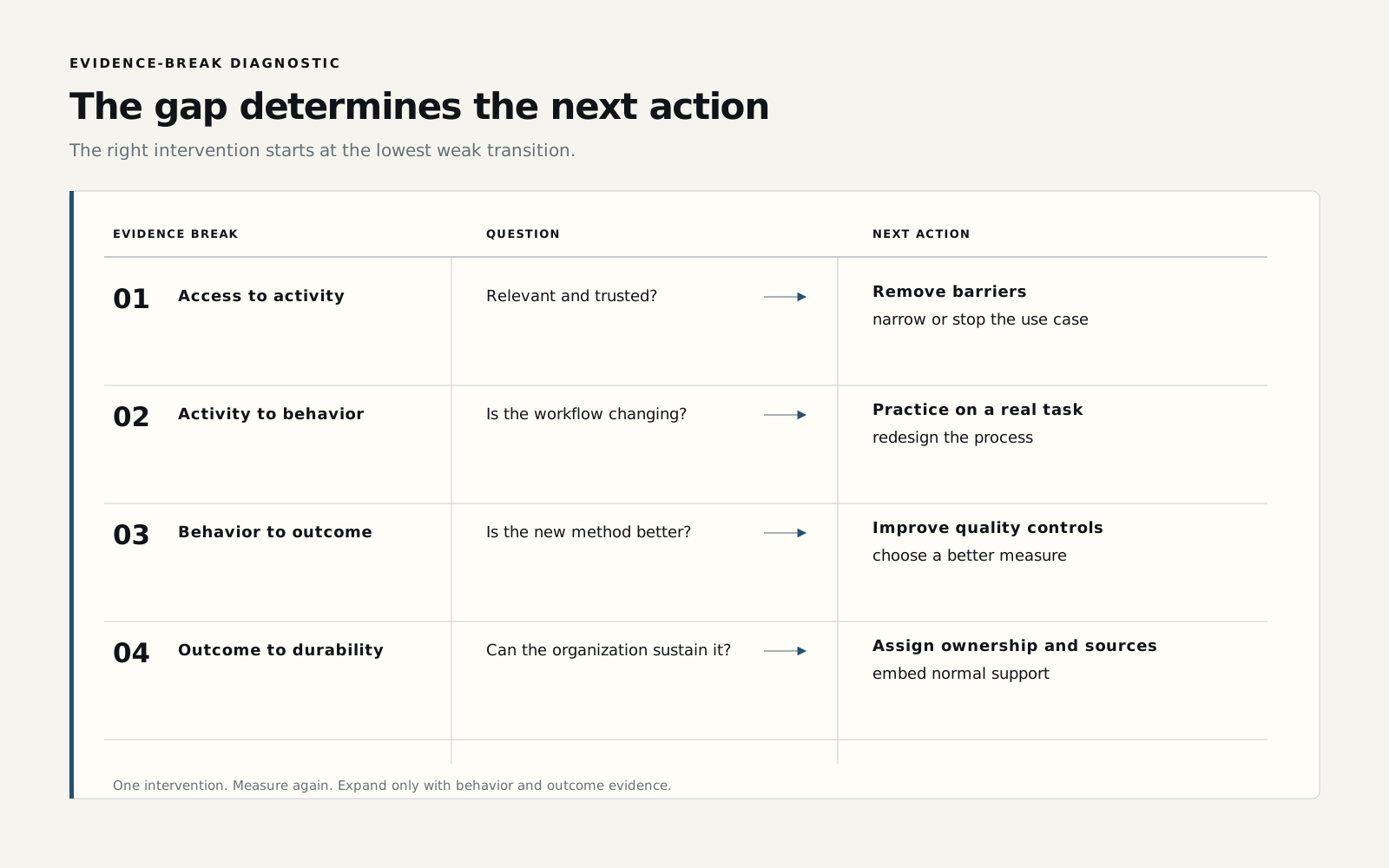
| Evidence break | Likely question | Appropriate next action |
|---|---|---|
| Access to activity | Is the capability relevant and trusted? | Remove barriers, narrow the use case or stop the rollout |
| Activity to behavior | Is Copilot changing the workflow? | Practice on a real task and redesign the process |
| Behavior to outcome | Is the new method actually better? | Improve quality controls or choose a better measure |
| Outcome to durability | Can the organization sustain it? | Assign ownership, maintain sources and embed support |
Measure a role and a task, not an abstract population
Organization-wide averages conceal the conditions that create value. Adoption usually happens in a role performing a recurring task with recognizable constraints.
Consider a proposal team using Copilot to prepare a first response to a request for proposal. Access evidence shows that the team is licensed and can reach approved reference material. Activity evidence shows repeated use in Word and search. Behavior evidence asks whether the team now begins from a grounded outline, uses a shared review checklist and stops recreating standard sections manually.
Outcome evidence then measures something operational: time to review-ready draft, number of unsupported claims, reviewer corrections and on-time submission. Durability asks whether the practice continues after the initial enablement period and whether the approved source set remains maintained.
This design is more commercially useful than measuring the total number of prompts because it reveals which part of the operating system needs attention.
Combine telemetry with operational evidence
Product telemetry identifies patterns at scale. It is strongest for questions about reach, frequency, feature mix and change over time. Use it to locate groups or tasks that deserve investigation.
Operational evidence explains the pattern. Short interviews, observation, work samples, process data and targeted surveys can show whether the old method was replaced, which steps still create friction and where quality changed.
Establish a baseline before the intervention. Compare similar periods and populations. Record other changes that may influence the result, such as a new template, seasonal demand or team restructuring. If the design only demonstrates correlation, do not claim that Copilot caused the outcome.
Self-reported time savings can guide investigation but should not automatically become a financial return. Convert saved time into economic value only when the organization knows whether that capacity was removed, redirected or used to improve output.
Protect employees while measuring work
Adoption measurement can quickly become employee monitoring if purpose and access are vague. Define what is being measured, why, at which level of aggregation and who can see it. Collect the minimum detail needed for the decision. Avoid individual rankings or performance conclusions from product activity.
Works council, data protection and employee representatives may need to be involved depending on the organization and jurisdiction. Their questions should shape the measurement design early, not arrive after a detailed dashboard has already been distributed.
A trustworthy system tells employees how evidence will be used and gives teams a route to challenge misleading interpretations. Measurement should improve the work, not create an opaque score of personal compliance.
Adoption requires more than training
Training is appropriate when people lack a skill. It is not the answer to every evidence gap. Low use may indicate poor source quality, a weak use case, missing access or a process that should be automated instead. High use with low value may require tighter quality controls or retirement of the scenario.
Effective enablement combines a relevant task, permission to change the process, guided practice, local examples, support and feedback. It also defines what not to use Copilot for. Confidence grows when people understand both the capability and its limits.
Use measurement as a learning loop
The purpose of the evidence ladder is not to produce a final adoption score. It is to choose the next action.
Review the ladder on a regular cadence. Identify the lowest level where evidence is weak. Select one intervention. Measure again. Expand only when the behavior and outcome justify it. Stop or redesign use cases that consume attention without improving work.
Amplified Pi uses this model to connect AI enablement with operational results. We establish the baseline, design role-specific adoption and combine product evidence with business measures. The useful next step is to select one role and one recurring task, then determine where its evidence currently stops.