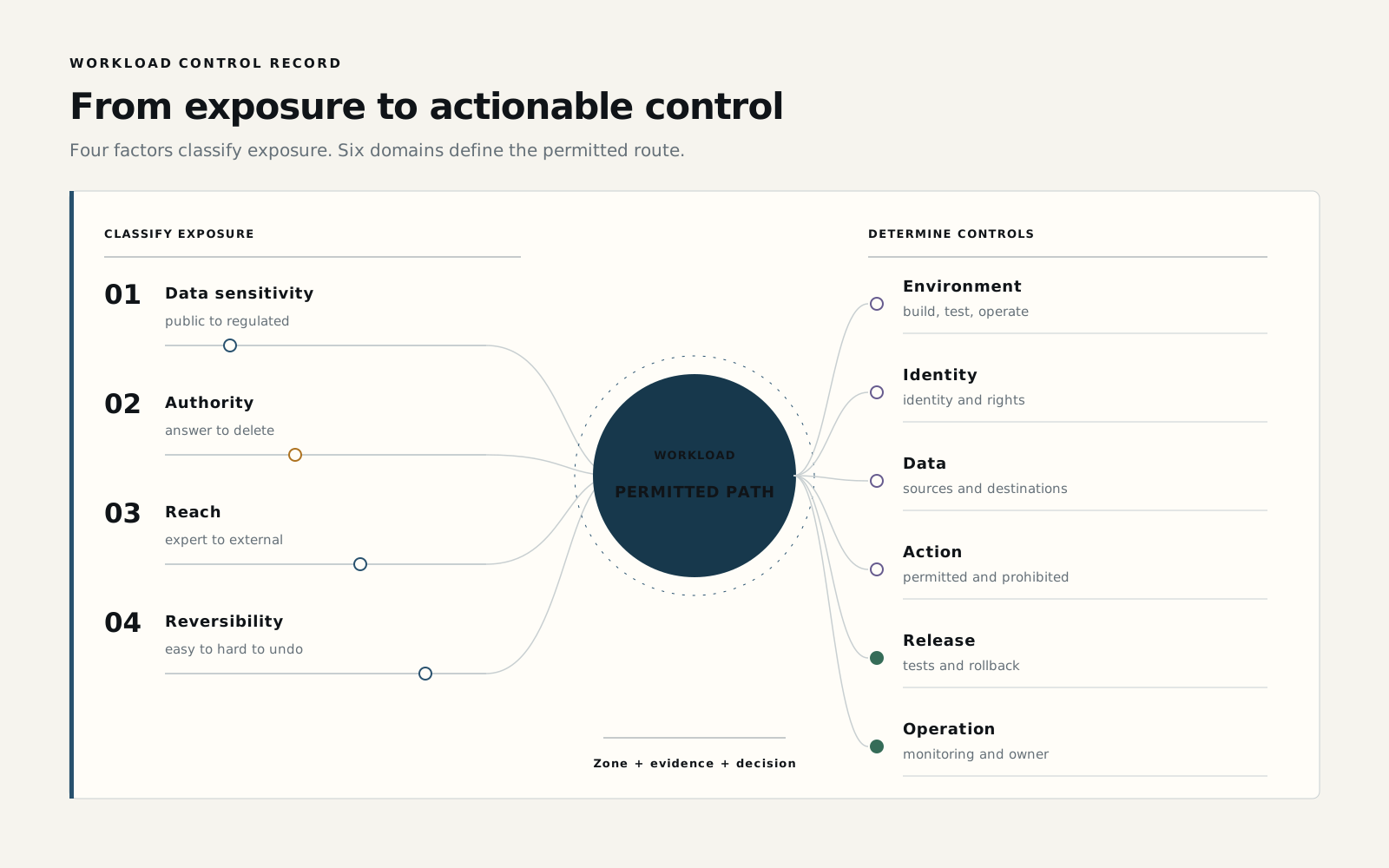
AI governance should determine how a workload may proceed, not simply whether AI is allowed. The useful unit of governance is the workload: its purpose, users, data, authority, reach and consequences. A personal drafting assistant and an autonomous process that changes supplier records should not pass through the same gate.
A practical control plane connects workload risk to six domains: environment, identity, data, action, release and operation. These controls become stronger as sensitivity, delegated authority, affected population and difficulty of reversal increase.
Why policy alone fails
High-level principles are necessary. They establish expectations for fairness, privacy, security, transparency and accountability. They do not tell a maker where to build, which connector may be used, who can approve an action or what evidence is required for production.
When policy is not translated into a delivery path, two bad outcomes appear. Teams wait for broad approval that nobody can confidently grant, or they continue in default environments and shared workspaces because the useful controls arrive too late.
Microsoft’s zoned governance guidance similarly separates environments and controls by purpose and risk. The model below extends that logic into a workload record that can survive product changes and apply beyond one platform.
A control plane closes the gap. It combines decision rights, technical guardrails and operating evidence. A team should know the permitted route before implementation begins.
Govern the workload, not the product label
The same product can support very different levels of exposure. One Copilot Studio agent may answer questions from approved internal documents. Another may retrieve employee information, make a recommendation and update a case-management system. Calling both “Copilot Studio agents” does not make their control needs equivalent.
Classify the workload using four escalation factors:
- Data sensitivity: Does it use public, internal, personal, confidential or regulated information?
- Authority: Does it only answer, or may it create, change, send, approve or delete?
- Reach: Is it used by one expert, a team, the organization or external parties?
- Reversibility: Can an error be detected and undone without material harm?
The product influences available controls. The workload determines which controls are needed.
Six control domains create an actionable record
| Domain | Decision to make | Typical evidence |
|---|---|---|
| Environment | Where may the workload be built, tested and operated? | Environment classification, regional placement and separation of development, test and production |
| Identity | Which user or service identity acts, and with which rights? | Authentication design, least-privilege roles, conditional access and owner records |
| Data | Which sources, connectors and destinations are permitted? | Source register, sensitivity, retention, data policy and permission tests |
| Action | What may the system recommend or change? | Tool allowlist, validation, approvals, prohibited actions and emergency stop |
| Release | What evidence is needed to promote a change? | Test results, security review, approval, version and rollback plan |
| Operation | How is the service observed and maintained? | Monitoring, audit, cost controls, incident process, support and periodic review |
The record should use plain language. “DLP configured” is not enough. State which knowledge sources and connectors are permitted, which combinations are blocked and what the user experiences when a policy prevents an action.
Use zones to make the normal path obvious
Three zones are sufficient for many organizations.
Exploration zone: personal or small-team learning with synthetic or low-risk data, constrained connectors, no consequential autonomous action and an expiry date.
Team service zone: real business use for a defined audience. It requires a business owner, approved sources, explicit sharing, basic monitoring, support and a controlled release.
Organization or high-impact zone: broad reach, sensitive data or consequential action. It requires separated lifecycle environments, stronger identity and data controls, representative evaluation, formal release evidence, incident response and periodic review.
Zones reduce repeated negotiation, but they should not become rigid categories. A workload can be escalated by one material factor. A small audience does not make an irreversible financial action low risk.
A worked governance decision
Consider a procurement assistant that answers policy questions and helps create supplier-onboarding requests. In its first form, it retrieves approved guidance and drafts a checklist for procurement staff. It runs in the team service zone with user-level access, controlled knowledge and no system changes.
The team then asks it to create suppliers automatically in the enterprise resource planning system. The product has not changed, but the workload has. The agent would now use a privileged integration, process commercial and personal data, and create records with financial consequences.
The control plane escalates the design. Supplier identifiers and required fields receive deterministic validation. Duplicate and sanctions checks remain authoritative external controls. A procurement employee approves the creation. The integration uses a restricted service identity. Test and production environments are separated. Creation events, failures and overrides are logged. The business owner reviews exception patterns.
Governance has not blocked the opportunity. It has changed the conditions under which greater authority becomes acceptable.
Put decisions at the earliest responsible point
Environment, identity and data choices are architecture decisions. Reviewing them after a prototype succeeds often creates expensive redesign. Governance representatives should therefore help define reusable routes, not attend every maker conversation.
Platform teams can publish patterns for common workloads: internal knowledge assistant, document drafting, request triage, approval support and action-taking agent. Each pattern can identify default environments, allowed connectors, required evidence and escalation triggers.
This creates controlled self-service. Makers move quickly inside known boundaries. Specialists focus on exceptions and higher-impact systems.
The counterargument: does this create more bureaucracy?
It can, if every workload requires a bespoke committee and a large document. A useful control plane does the opposite. It standardizes common decisions, automates enforceable controls and asks for additional evidence only when exposure increases.
Another risk is false assurance. A green zone does not make every implementation safe. Ownership, source quality and behavior still require verification. Zones describe the expected route; they do not replace professional judgment.
Measure whether governance enables responsible flow
Do not measure governance only by policy completion or blocked actions. Track time from concept to classified experiment, time from pilot to production decision, percentage of workloads with owners, exceptions, orphaned assets, control failures and incidents. Also track how many experiments are stopped because evidence does not justify expansion.
A healthy system produces both safe releases and clear negative decisions. Its purpose is not maximum deployment. It is faster, more consistent movement toward the right outcome.
The next practical step
Select five real AI workloads at different stages. For each, record the four escalation factors and six control domains. Where teams disagree, the disagreement reveals the governance design work that matters most.
Amplified Pi helps organizations turn that diagnostic into risk zones, technical guardrails and a release path. Governance becomes part of Strategic AI Rollout: a mechanism for moving valuable work into operation under proportionate control, not a wall built after the opportunity is already waiting.